FREE Product-Led Storytelling Playbook
Get nowUse AI in B2B Content Marketing; But Never for These
Adopting AI tools? This guide explores four areas where using AI in B2B content marketing is effective. And areas you shouldn’t.


Victor Eduoh
Lead Strategist @VEC
Quick one for you.
Assume you knew another B2B SaaS company was using artificial intelligence (AI) to create all its content marketing pieces. Would you still want to read what they publish and trust the info they share?
I asked the same question in a recent LinkedIn post. And Haris Spahić, Content Lead at ButterDocs, responded, “I don’t want to read something no one bothered to write:”
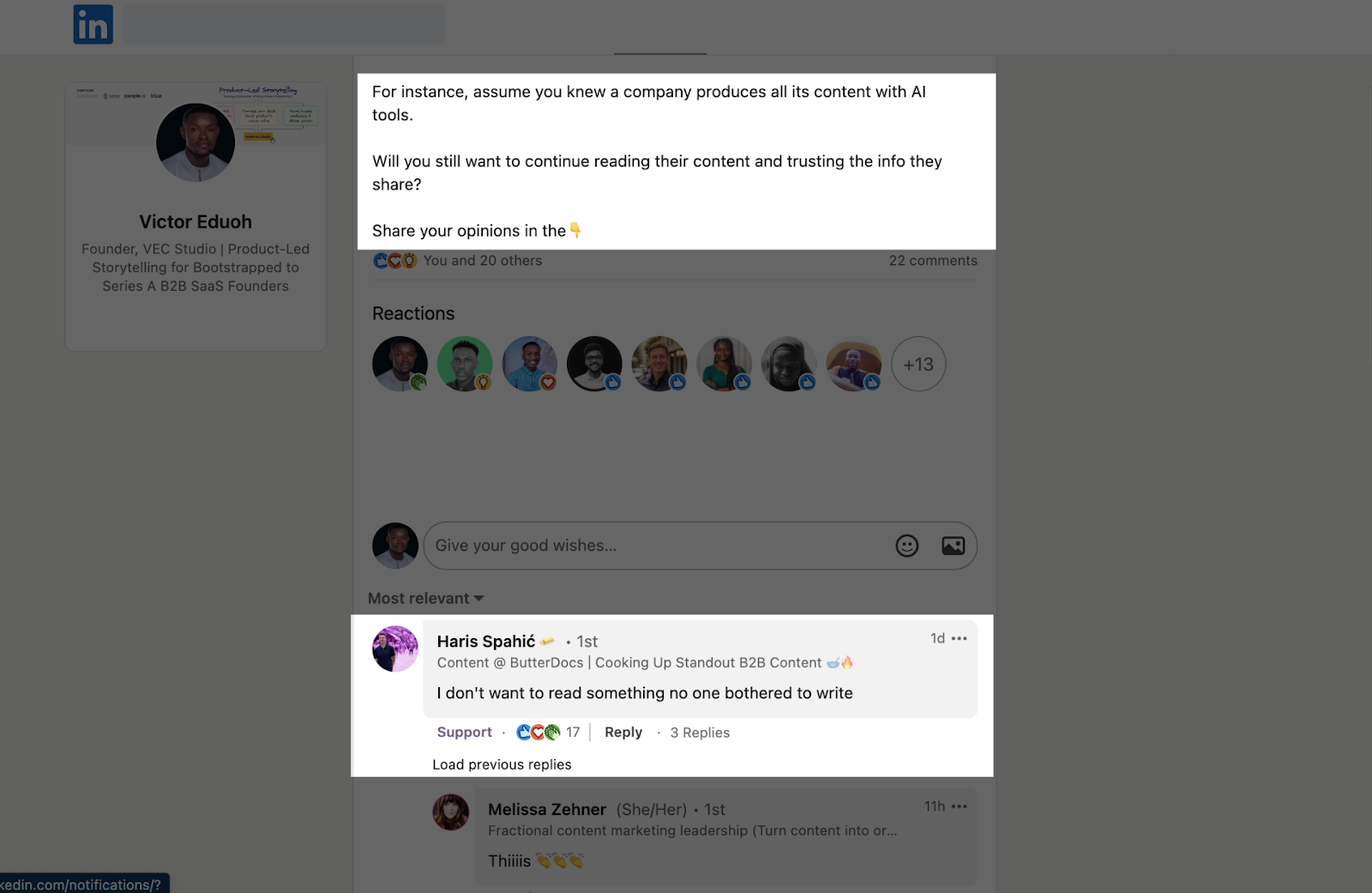
His response got the most supportive reactions, as you can see above. This indicates how people —your prospects and customers— may react if they knew your startup was auto-generating content with AI. Yeah, a few people’s take on my post doesn’t mean neglecting the value of using AI. Doing so may be throwing the baby out with the bathwater, as I must admit that, given the right prompts, most AI tools can now write better than some humans.
But it touts an old-age question.
If a tree falls in the forest, and there’s no one to hear it, does it make a sound? Think of this in the context of creating marketing content. The goal is often to have it read by the prospects and customers you’re trying to attract, convert, or retain. If using AI tools to create content makes it less likely for people to want to read said marketing content, is AI even worth its rave?
If no, then…
Why is AI in B2B Marketing All the Rave?
Salesforce, pioneer of the B2B SaaS business model, now positions itself as ‘the #1 AI CRM.’ Intercom, a leading customer service SaaS, have recently revamped their entire website. They now claim to be ‘the only complete AI-first customer service platform.’ Their arch rival, Drift, now starts its underlying value proposition statement as ‘...an AI-powered buyer engagement platform…”
It’s not just known B2B SaaS behemoths.
According to TechCrunch, despite widespread decline in startup investing, funding for AI tools surged in the past year. Capital toward generative AI startups alone surged almost 8x from 2022 to 2023, reaching over US$25.2 billion by the end of December 2023. Even Y Combinator (YC), the famous Silicon Valley-based accelerator, seems to now prefer incubating AI ventures. For instance, it accepted about 86 AI startups in its Winter 2024 Batch, nearly double the number of such startups accepted a year prior.
My point?
The AI rave is everywhere you turn.
And more so for marketing-related purposes. Because if you unpack what’s driving this trend, Large Language Models (LLMs) made popular by the likes of OpenAI’s ChatGPT, Google’s Gemini, Anthropic’s Claude 2, and others, are at the forefront.
Through APIs or open source, any marketing technology (MarTech) can plug into the generative AI capabilities of these models. Hence, the widespread promise of accelerated automation of marketing tasks. Chief of this is auto-generating marketing content from a few prompts. Sounds honest on paper. But Phyllis Davidson, VP Principal Analyst at Forrester, noted why B2B Marketers eager to adopt these tools for such a promise should do it with a grain of salt.
According to Phyllis:
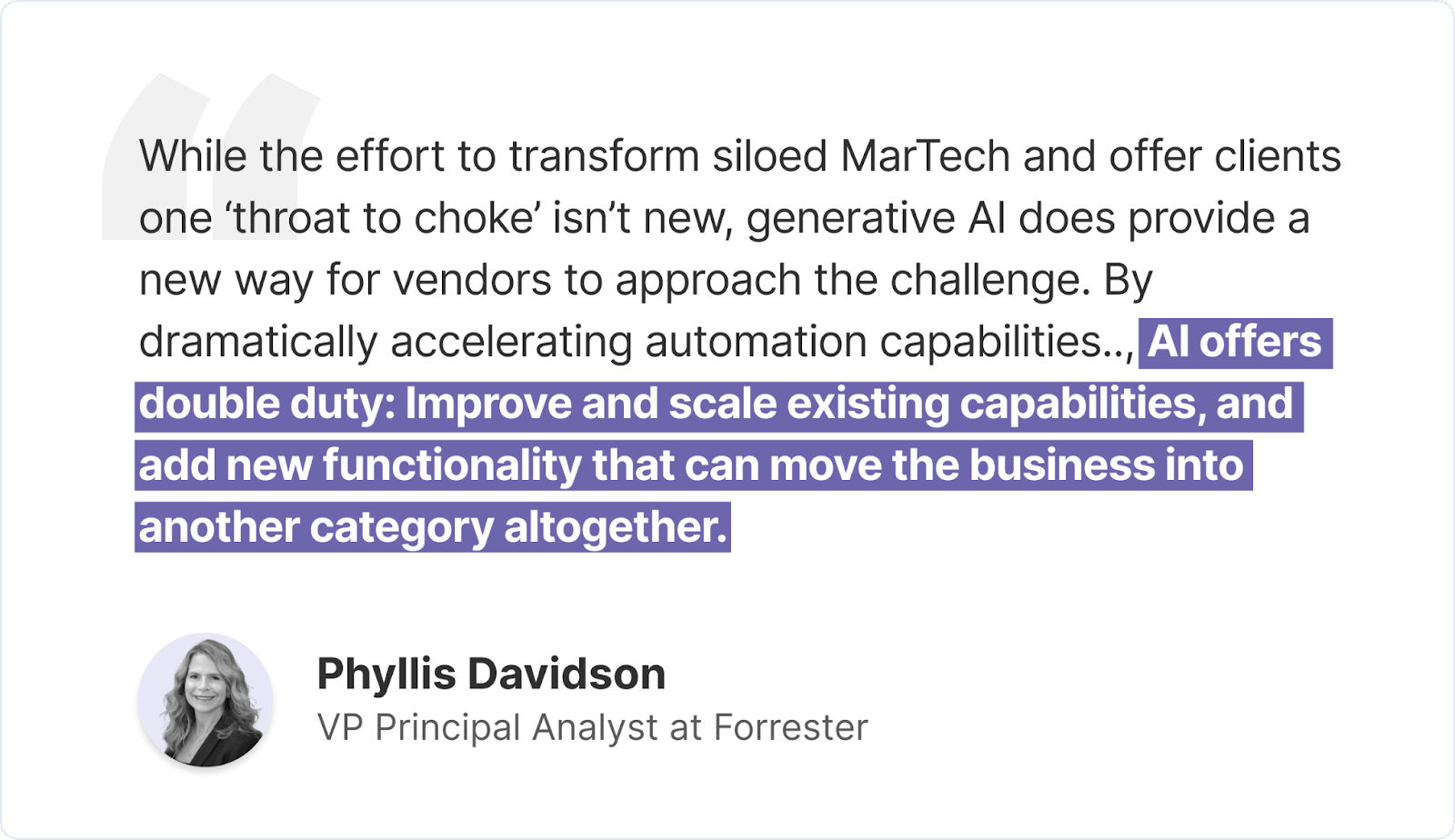
In other words, AI tools’ can help you to auto-generate content at scale. But they won’t necessarily help you to achieve your business goals. As Phyllis observed, tools are integrating LLMs and AI to unlock new revenue streams for themselves. And to appeal more to investors by moving their business into the trending category.
It follows that if you must use them, you should also put your own interest first. How you do this is by identifying areas where using AI tools actually makes your B2B SaaS content writing more effective.
Effective Use of AI in B2B Content Marketing
Jason Foster said it best:
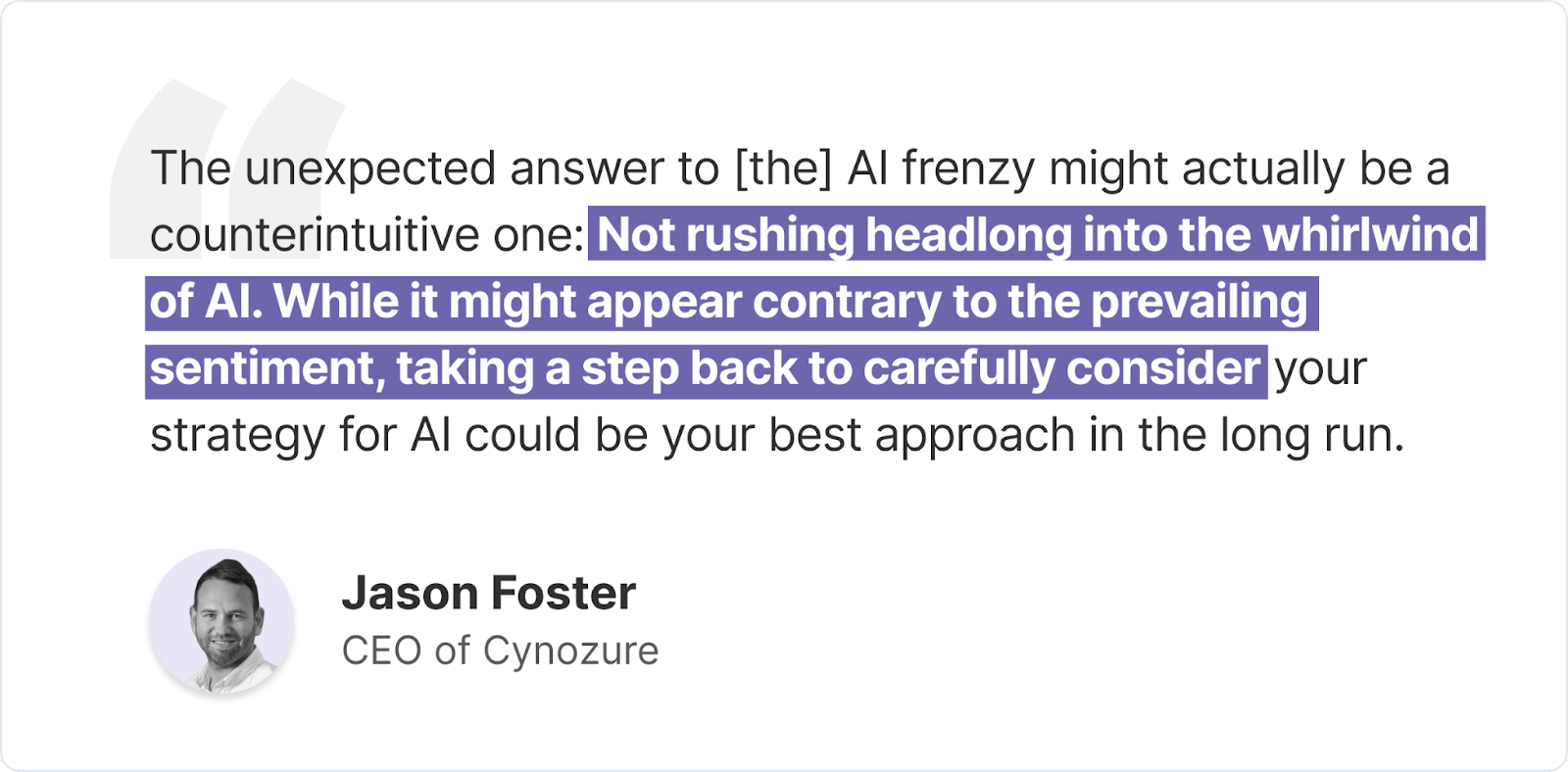
Per Jason’s advice, I took some steps back to examine areas where using AI can be effective for B2B content marketing.
Such areas are…
1. Brainstorming & Keywords Research
OpenAI’s ChatGPT, for instance, was trained on imaginable amounts of data. Over 570GB of datasets, including webpages, books, and other sources, to be specific. And as of November 2023, it was processing more than 10 million queries a day from about 100 million users/week.
This vast amount of data is nothing short of amazing. But what makes ChatGPT and other LLMs-powered AI tools valuable is their ability to analyze this data and generate insights you couldn’t obtain manually. It makes them a no-brainer for brainstorming content ideas and preliminary keywords research.
Take this article.
In my preliminary research phase, I needed to brainstorm ideas and find relevant keywords. So I prompted ChatGPT with, “what are some crucial keywords for a blog on ‘AI in B2B content marketing?’”
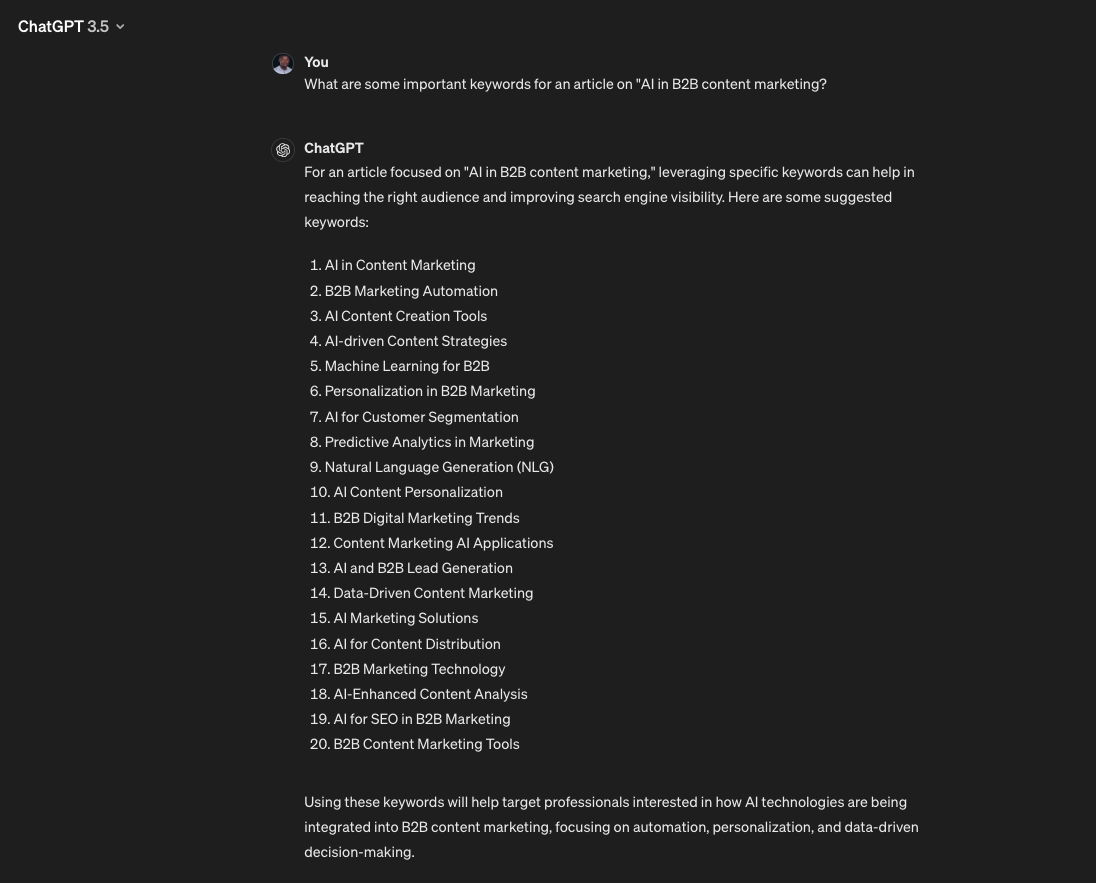
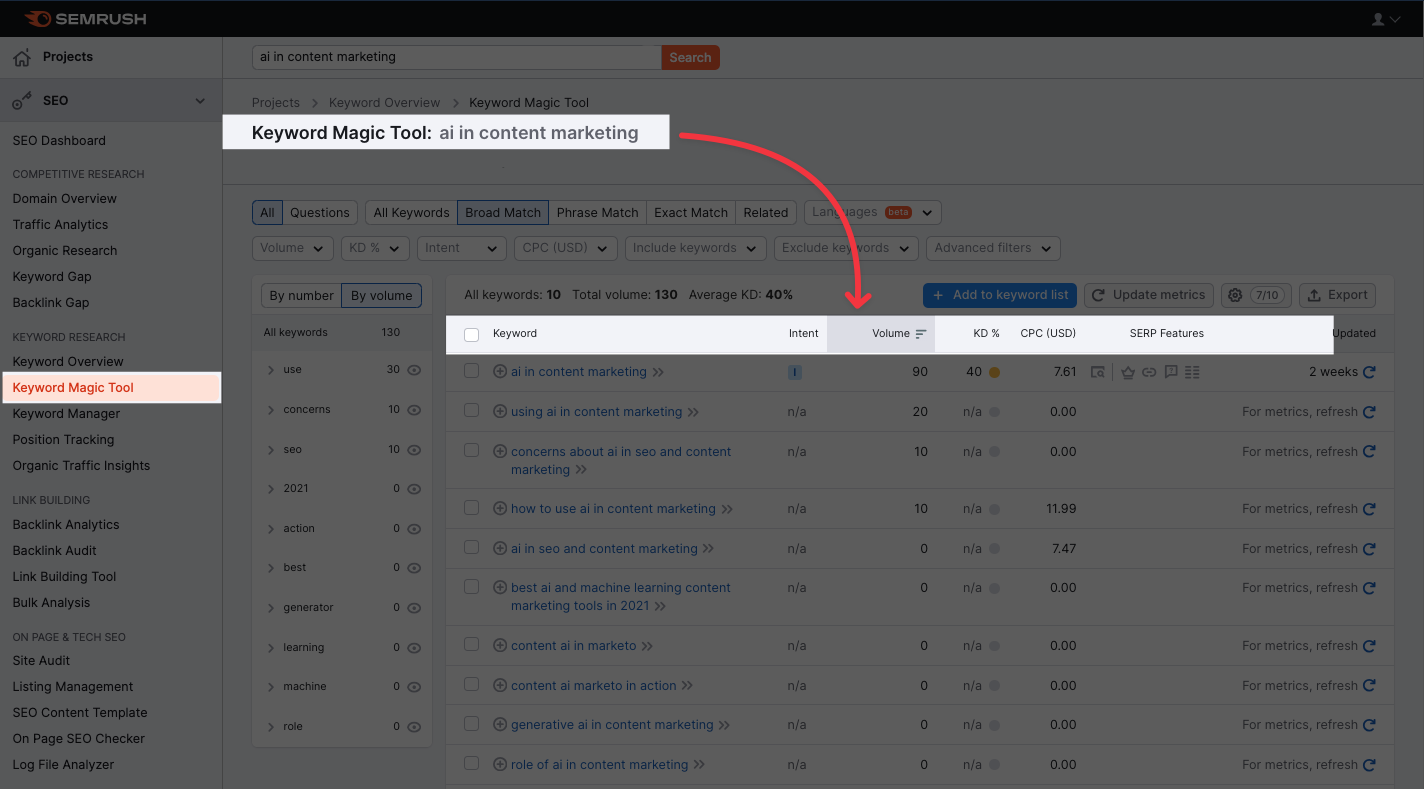
You won’t get search volumes and other SEO insights from LLMs. However, I recommend starting with them as the suggested keywords are often from queries processed from others. Once you have a list of keywords from ChatGPT, move to a more grounded, AI-powered keyword research tool, like SEMrush’s Keyword Magic Tool.
Here you’d get useful info like search volume, CPC, keyword difficulty, search intent, and other crucial metrics:
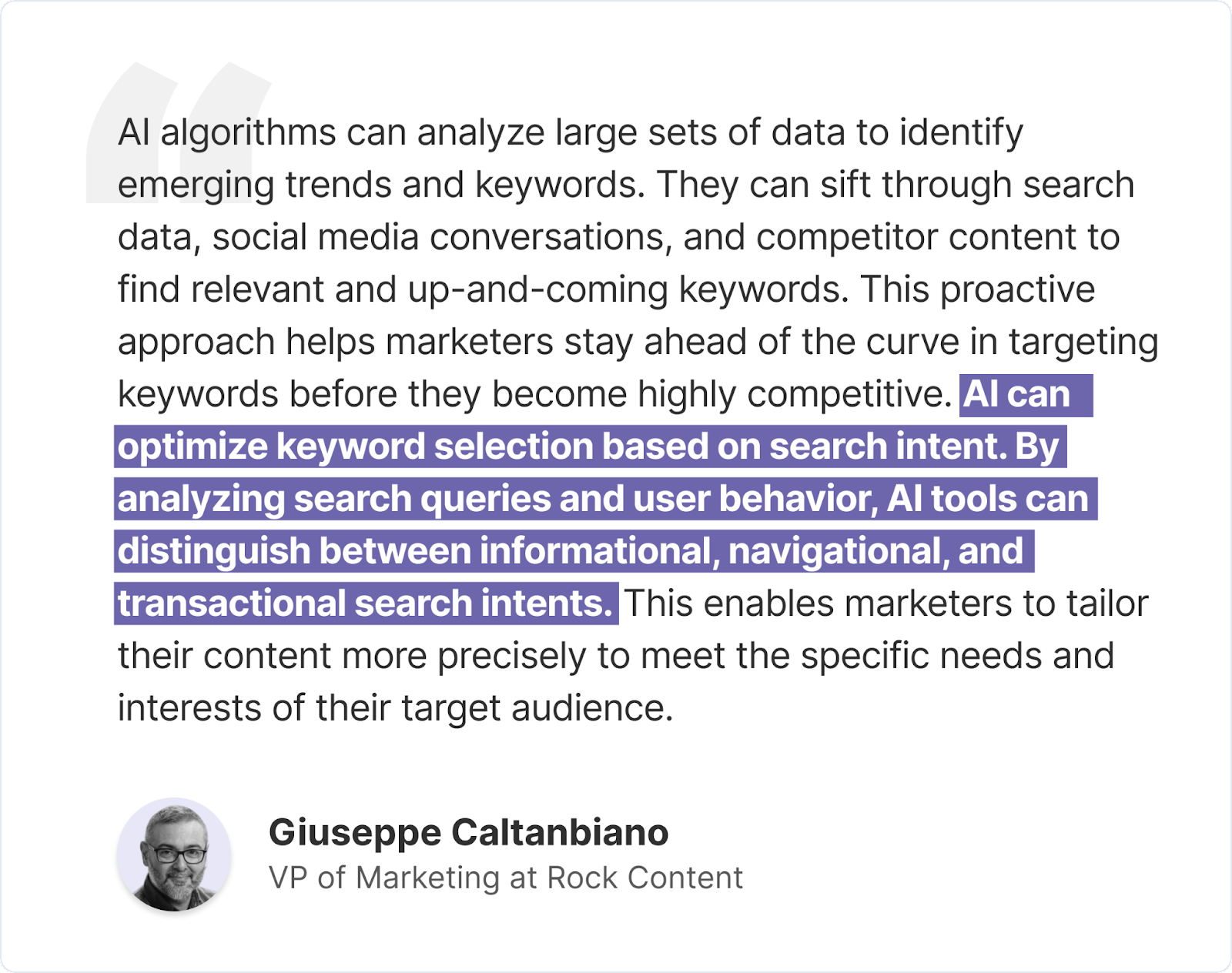
AI algorithms’ ability to analyze large amounts of data and provide useful insights, as you can see above makes them a must-use. Says Giuseppe Caltanbiano, VP of Marketing at Rock Content:
2. Digging Out Content Creation Insights from Existing Data
From my experience, the average B2B SaaS company talks to a lot of prospects and customers across support and sales calls. And if you’re like most today, you probably have a podcast or host lots of educational webinars, where you invite expert guests.
Buried in all these events are rare insights for creating exceptional B2B content. But they often get overlooked because content teams lack the skills or time to dig into them when creating content.
Generative AI tools solve this.
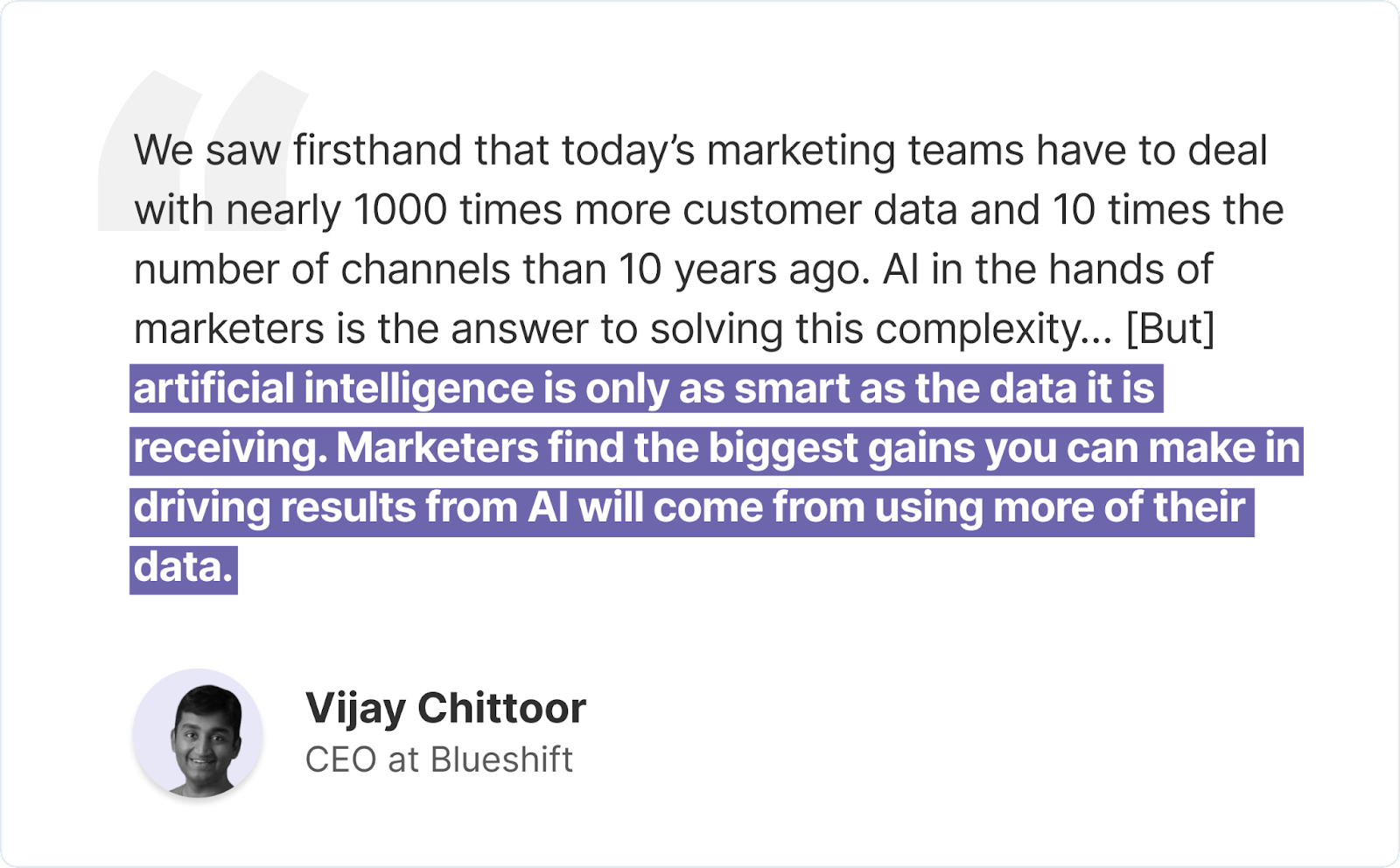
Their growing ability to summarize call recordings’ transcripts, and generate content creation insights, is exceptional. AI is definitely better and 100x faster than human beings at handling and analyzing large amounts of customer data from marketing events across all channels. Also, AI is as smart as the data you feed it. So the more of your company data you feed it, the more it can generate content creation insights relevant to your business. And the more those insights are likely to resonate with your existing customers and prospects, safe for strong editing, of course.
Vijay Chittoor corroborates
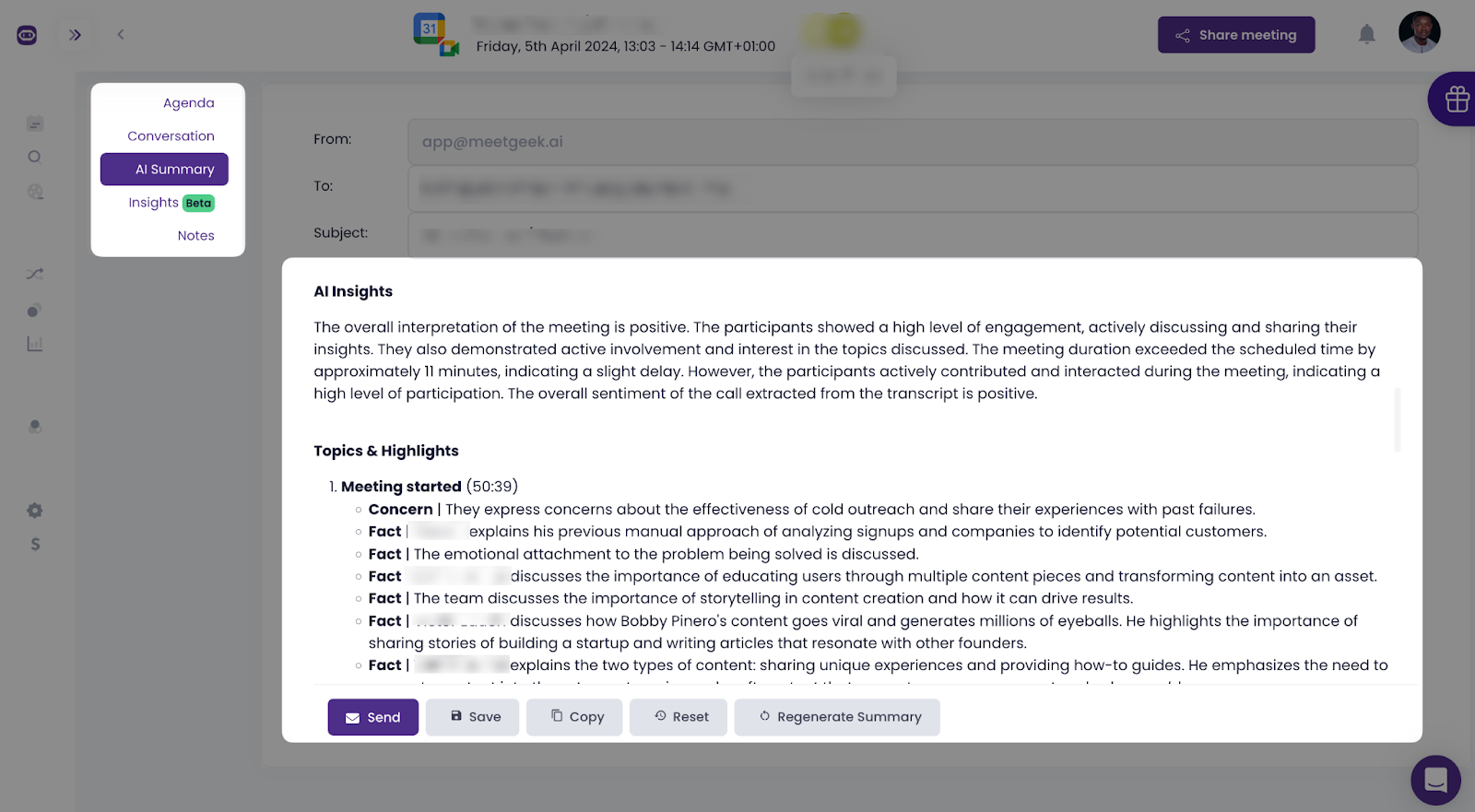
There are many generative AI tools you can leverage for digging out content creation insights. And the list is only getting longer by the day. But two we’ve been using extensively for the B2B SaaS clients working with VEC Studio are MeetGeek and Castmagic.
When we onboard new clients, we urge them to get a MeetGeek account, and invite the bot to join all crucial sales and customer support calls. When they share this with us, we get auto-summarized transcripts with rare insights into the crucial points discussed in meetings, which we can use in creating content as necessary:
Castmagic, on the other hand, doesn’t join calls.
Instead, it allows you to upload audio or video of podcast recordings, support and sales calls, webinars, and so on. Once uploaded, this AI tool auto-summarizes each upload per to customizable prompts. You can also query the tool for specific insights on a topic discussed in each uploaded asset and get near-instant ideas for creating content.
Here’s the more interesting part. With Castmagic, you can combine uploaded assets and prompt the AI to auto-generate content based on insights shared in those combined assets:
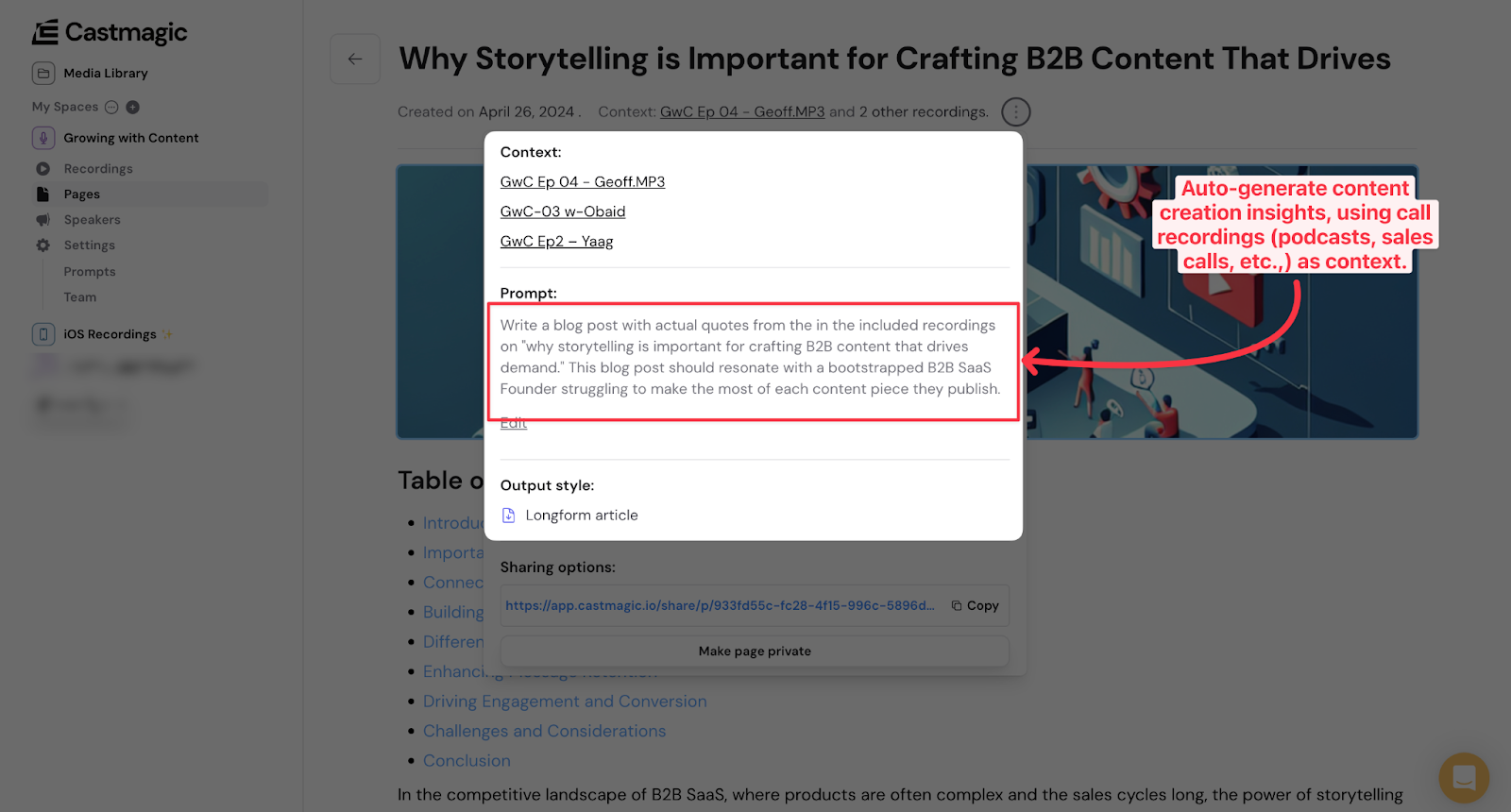
The drafts we get from this still go through a shit ton of edits. But the amount of work it saves us from manually digging into transcripts in search of usable content creation insights like quotes, expert perspectives, and so on, is bonkers. This area is therefore an effective use of generative AI for B2B content.
3. Co-Writing & Editing Guardrails
We started using Grammarly for basic content grammar edits at VEC Studio long before AI became mainstream. I’m talking about early 2017, when auto-generating marketing content with a few prompts wasn’t talked about much or encouraged as it is today.
It’s a different story today.
Software like Grammarly have come a long way to become a must-have for B2B content marketing. They now offer more than just grammar edits and can provide editing guidelines for the entire company to ensure all writing matches the brand’s tone.
And because they couldn’t be left out of the generative AI boom, they’ve also evolved into effective, AI co-writing aids. Besides Grammarly, we’ve used ProWritingAid and Writer to effectively co-write and define editorial guardrails at VEC Studio.
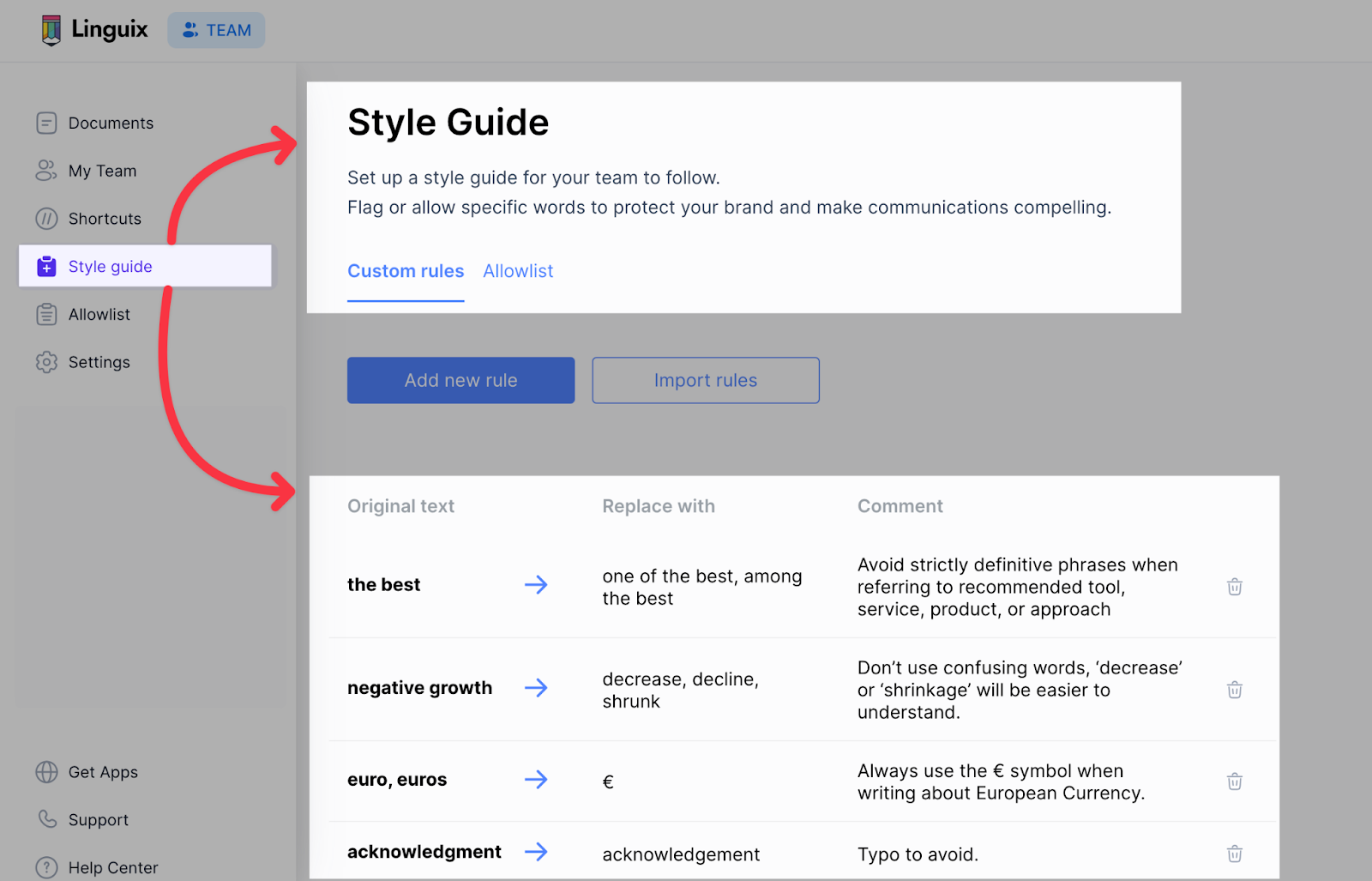
We use Linguix for the same today.
For instance, we establish company-wide editing guardrails that automatically deal with non-compliant words or phrases by defining them in our Style Guide on Linguix:
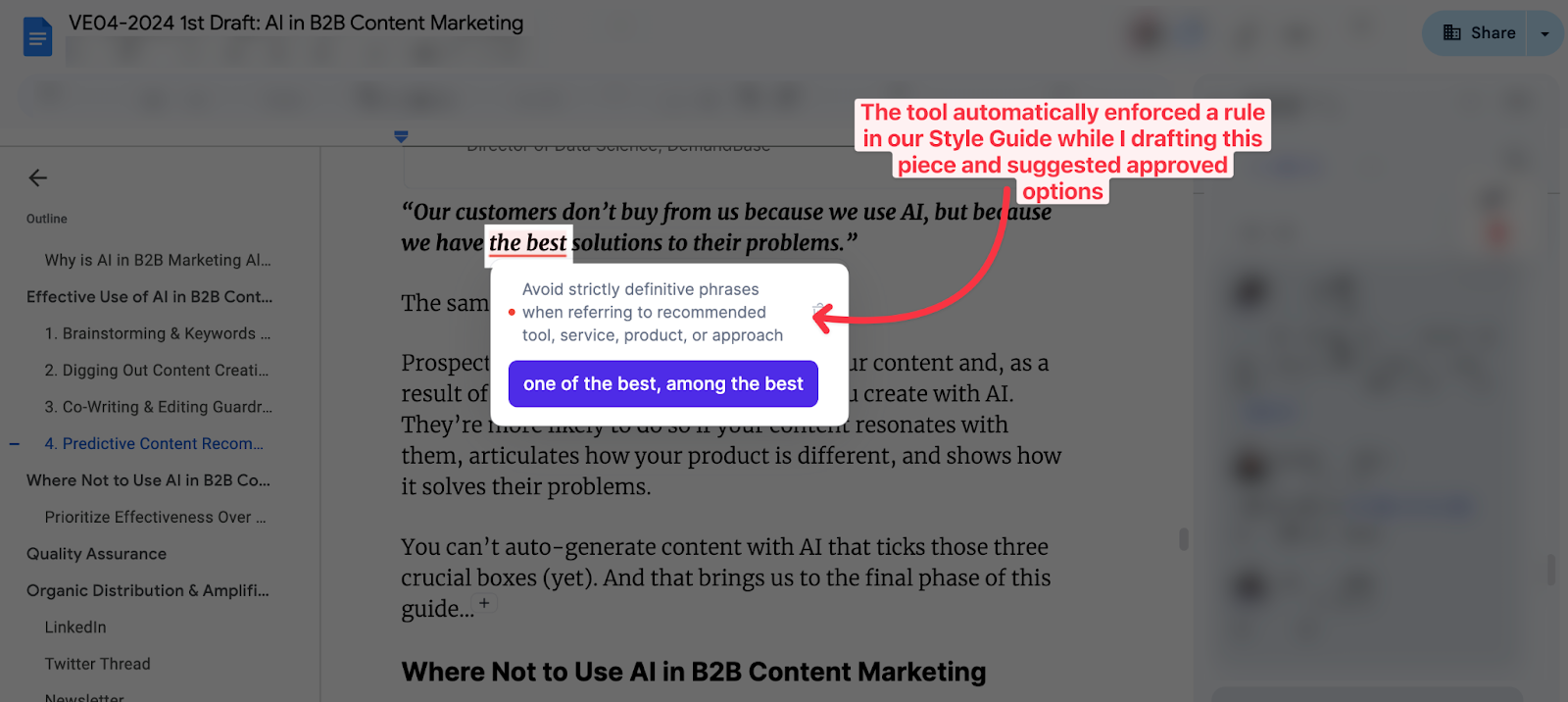
This tool, like others like it, works across the various places we create marketing content. So whether I’m drafting an email, writing social posts, or a content piece on Google Docs, the rules in our Style Guide are enforced automatically:
Also, it helps me (and other VECians) to co-write, rephrase, and autocorrect grammar errors we couldn’t have caught otherwise.
It can also expand ideas, as below:
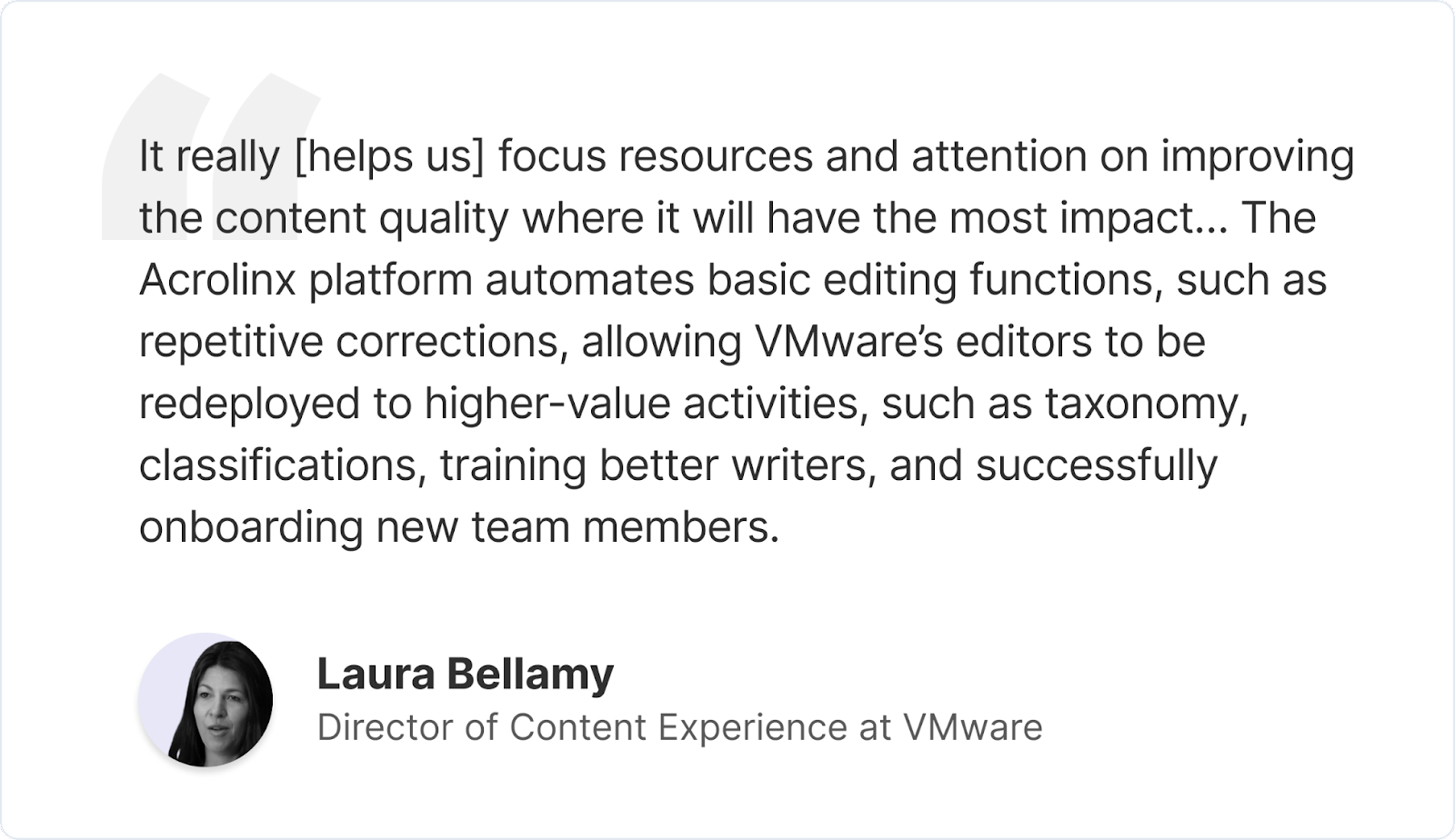
I consider generative AI tools like this a must-have for effective B2B content marketing. They automate basic editing functions and speed up the content creation process. VMware’s team experienced the same when they used a similar tool called Acrolinx.
According to Laura Bellamy:
4. Predictive Content Recommendations
The more content your marketing team creates, the more likely for previously created content to get buried by new ones. Also, not all your vital marketing resources will rank high on the SERPs for prospects and customers to discover them if they searched.
Given these realities, how do you ensure prospects and customers find content with info on how to tackle specific problems when needed? Predictive content recommendations enabled by generative AI.
A classic example, which led me to include this option, was when I needed to add images to a cold outreach campaign on Instantly. After struggling to find a resource with info on how to do this when I researched, I went to the chatbot within the product:
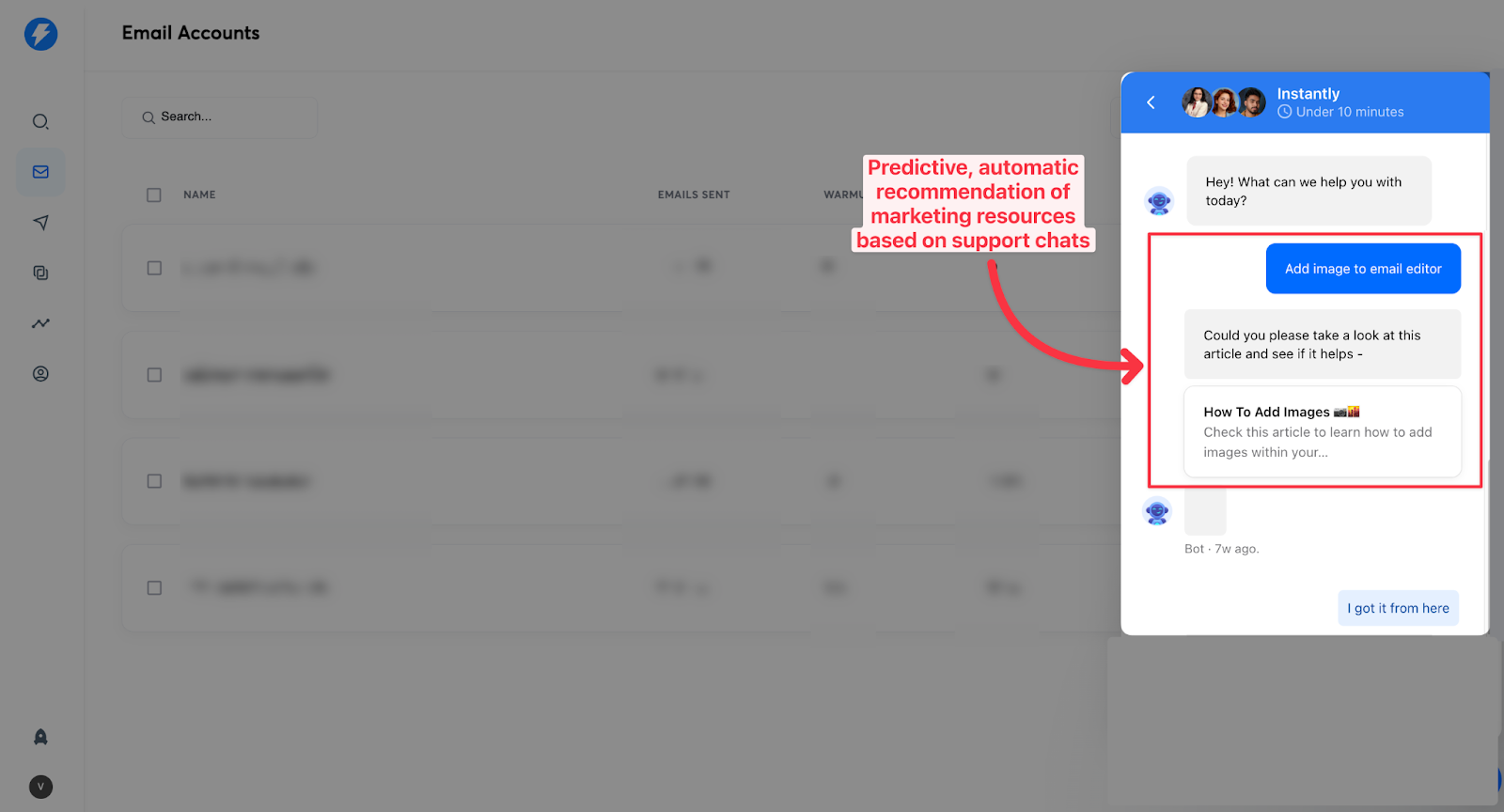
I consider this generative AI capability a must-have because it makes B2B content distribution proactive. It removes the sour experience of your existing users fumbling about in search of already created marketing resources on how to solve specific problems with your product. Instead, they can simply find them by engaging with the chatbot installed across your website and product.
All you have to do is continuously train the AI in your chatbot by feeding with every new marketing resource created. There are many products in this category. The more popular ones include Intercom, Zendesk, Help Scout, and Freshdesk. I’ve not used any of these tools or have VEC Studio worked with a company that used them.
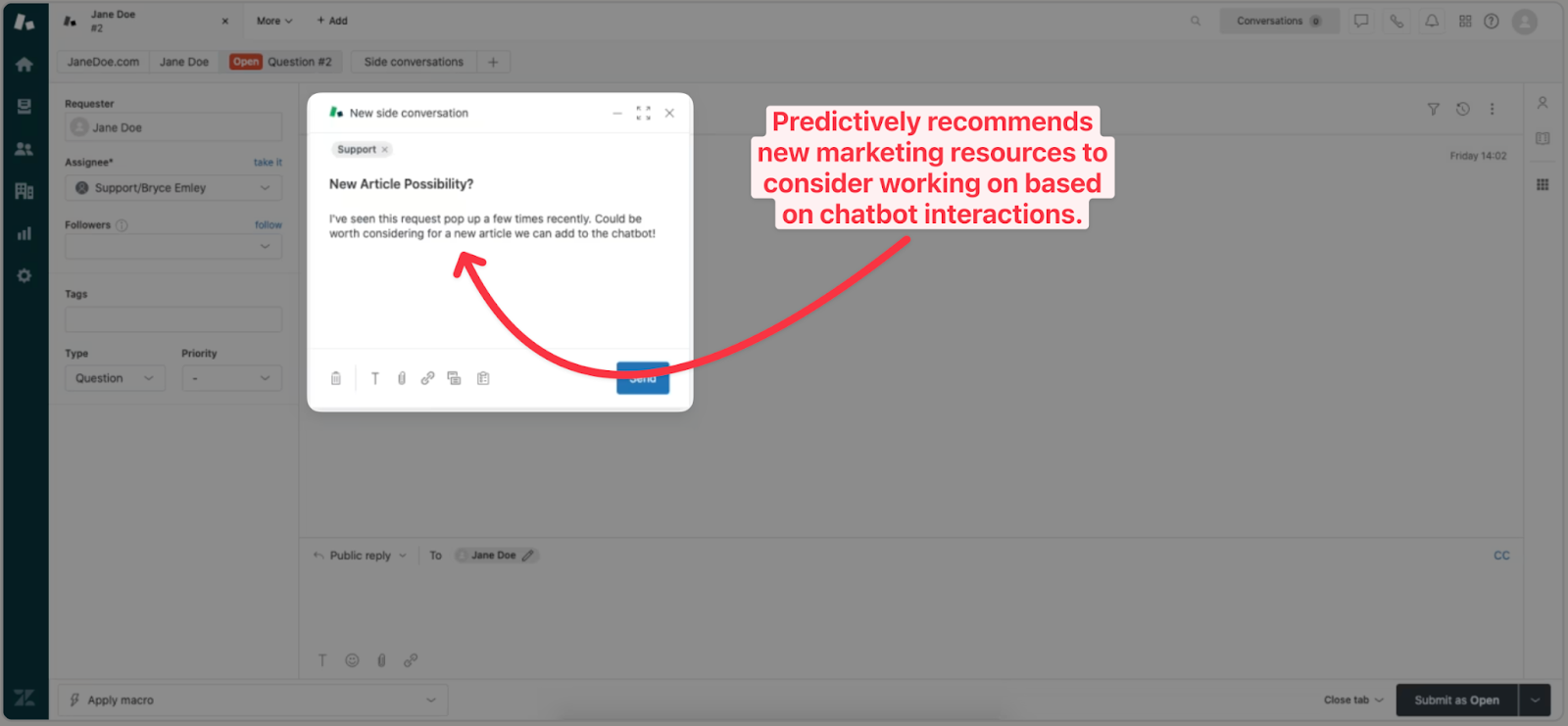
But based on my research when drafting this guide, I’d recommend Zendesk for one thing. It has an AI capability that auto-recommends new marketing resources to create, based on chat interactions:
And that’s a wrap.
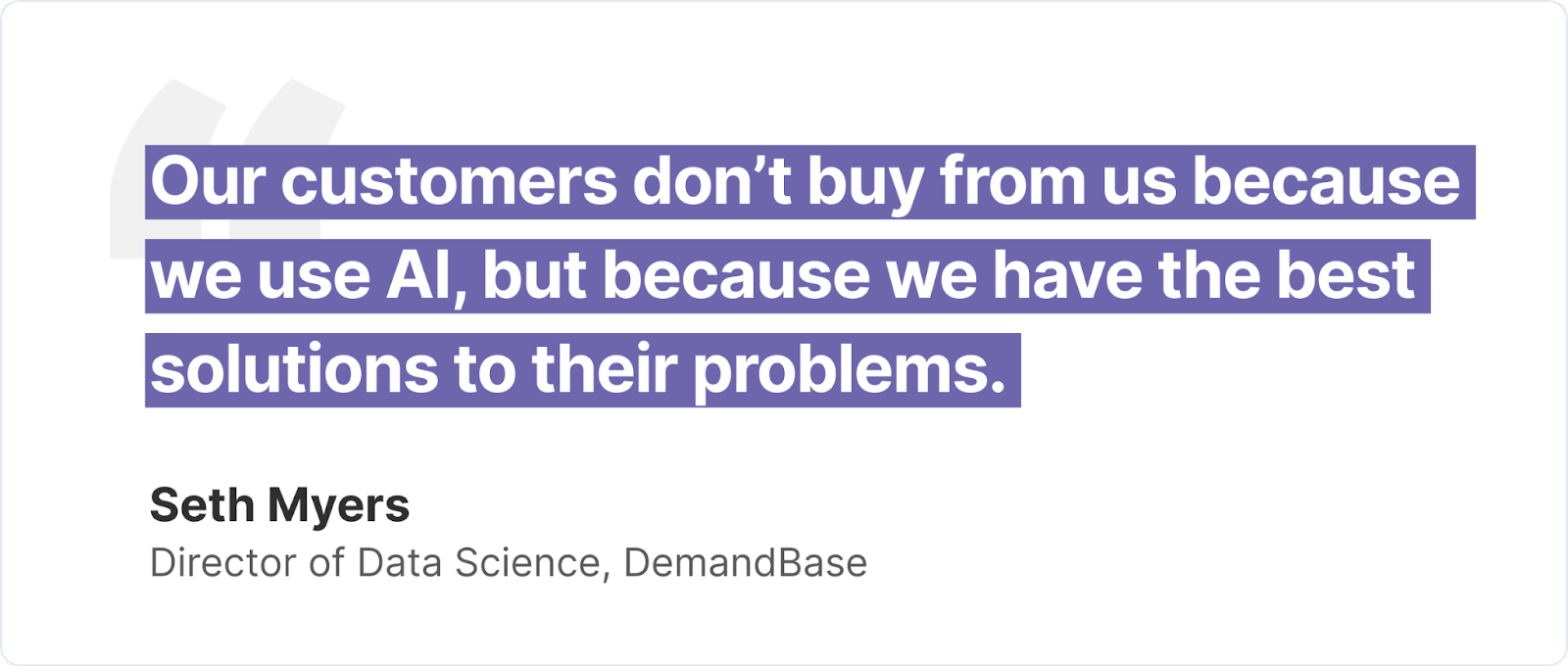
A wrap on the areas my VEC Studio team see and put AI to effective use in B2B content marketing. But I’ll conclude this section with an essential perspective from Seth Myers, Director of Data Science at DemandBase. On how the AI capabilities in their product helped a B2B SaaS company drive growth, he said:
The same applies to you.
Prospects and existing users won’t read your content and, as a result of that, buy your product because you create with AI. They’re more likely to do so if your content resonates with them, articulates how your product is different, and shows how it solves their problems.
You can’t auto-generate content with AI that ticks those three crucial boxes (yet). And that brings us to the final phase of this guide…
Where Not to Use AI in B2B Content Marketing
Common knowledge is that, today, attention spans are low. Related to that is the fact that people no longer read, but now only skim content. If there’s any iota of truth in any of these, then it’s probably safe to say that… We don’t need more content for the sake of it.
Think of that (and this👇) for a second.
Many years back, Brian Dean of Backlinko popularized ‘Skyscraper Content.’ His concept posited that new content had to be 10x better than existing ones to drive any meaningful outcome. But Rand Fishkin, then CEO of Moz, hinted at this several years earlier in one of his flagship ‘Whiteboard Friday’ videos. Rand showed in the episode how content must resonate deeply with people to even earn their attention. And that to convert a small fraction of traffic marketing content drives, you need to consistently create better and more resonate content that appeals to and retains loyal followers.
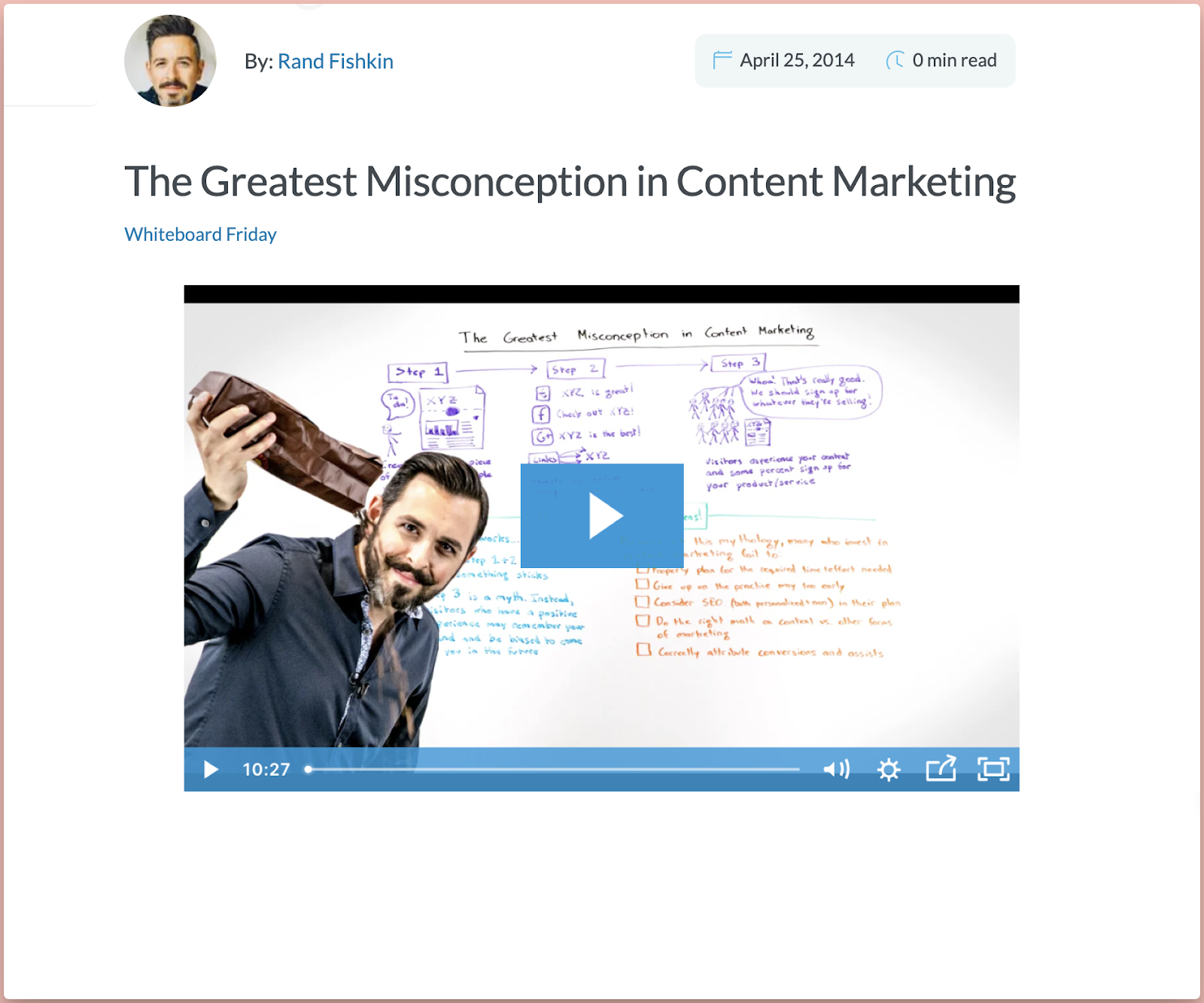
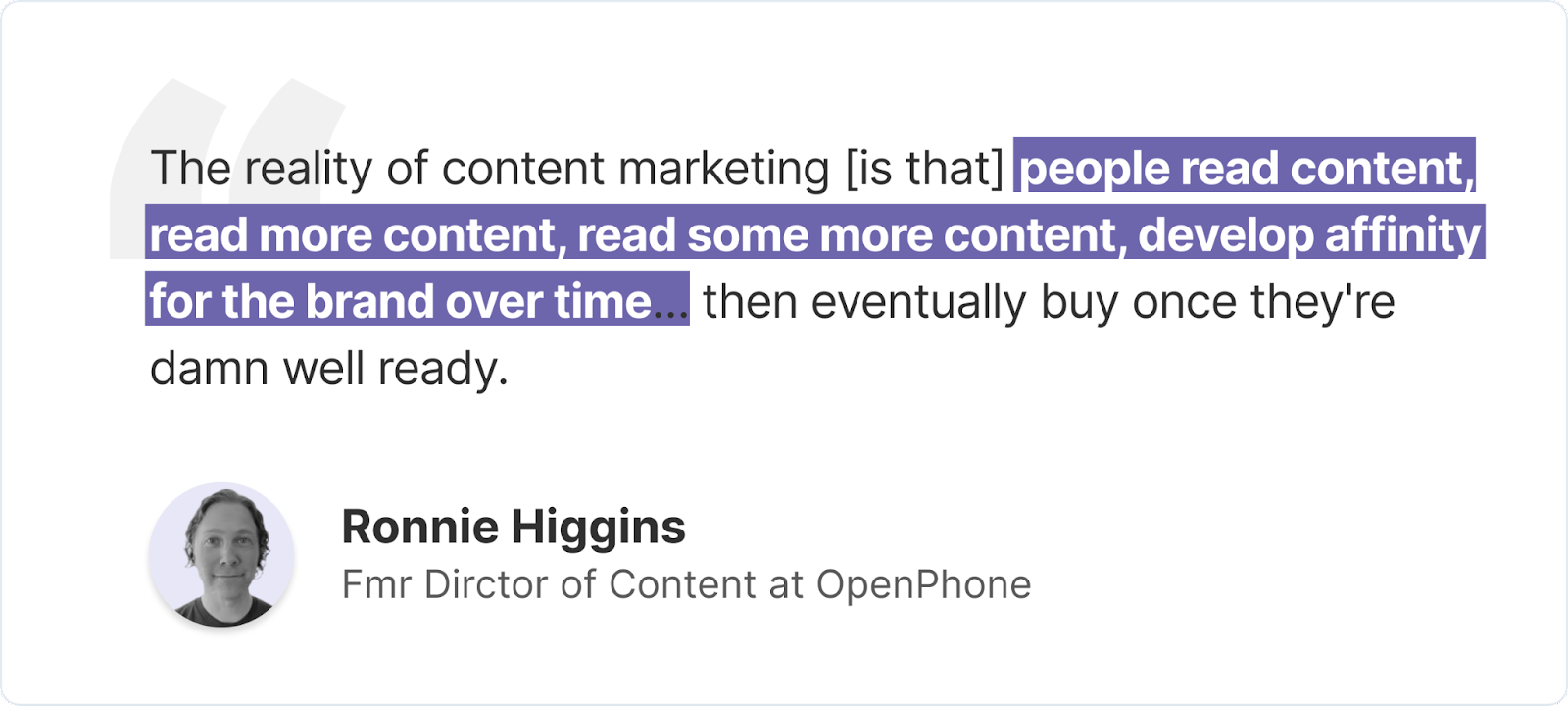
Ronnie Higgins, Fmr. Director of Content at OpenPhone, recently summarized what Rand Fishkin noted in 2014.
According to Ronnie:
If you agree, then it begs two questions.
Say you auto-generate your marketing content with a few AI prompts. Will it be 10x better than existing content on the web on the same topics? Most importantly, will people —your prospects & customers— read it, read more of it, read some more of it, develop affinity for your brand over time… then eventually remember your brand and product once they’re damn well ready to buy?
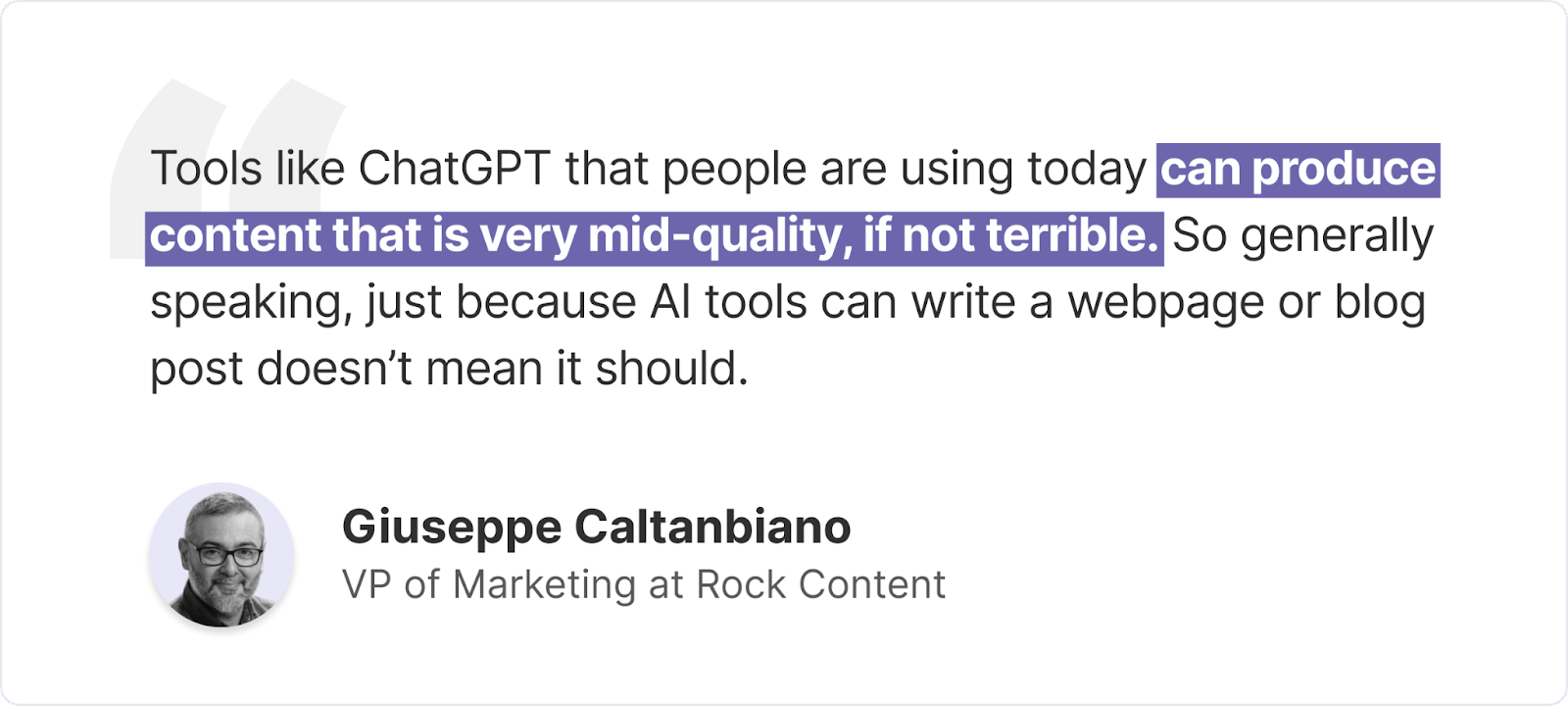
The obvious answer to both questions is why you should think thrice before falling for the content at scale efficiency AI tools promise. If all you want is to have regurgitated versions of existing content on your site, by all means auto-generating them with AI is your best bet. But if you want to craft, emphasis on craft, content people will actually want to read, and drive meaningful business outcomes from it, don’t expect AI to automate that for you with a few prompts.
Says Giuseppe Caltabiano:
Agree?
Then avoid using AI tools to breeze through your content marketing strategy design. This needs to be thoughtfully done, so it aligns well with your brand narrative, unique PoVs, and product features. Second, think twice before choosing AI-generated ideas to write about when building your content plan. Prioritize ideas from real interactions with your prospects and customers. And ideas that advances your narrative and articulates how you’re different from the competition, demonstrates how your product features uniquely solves buyers’ problems, and enables your sales efforts.
Lastly, don’t fall blindly for the higher efficiency lure of using AI tools to auto-generate marketing content. If you must, first ensure you’ve nailed the storytelling and angle in each piece through deep, strategic thinking. This will help each marketing content you create effective, standout and resonate well with your prospects.
We do as I recommend at VEC Studio.
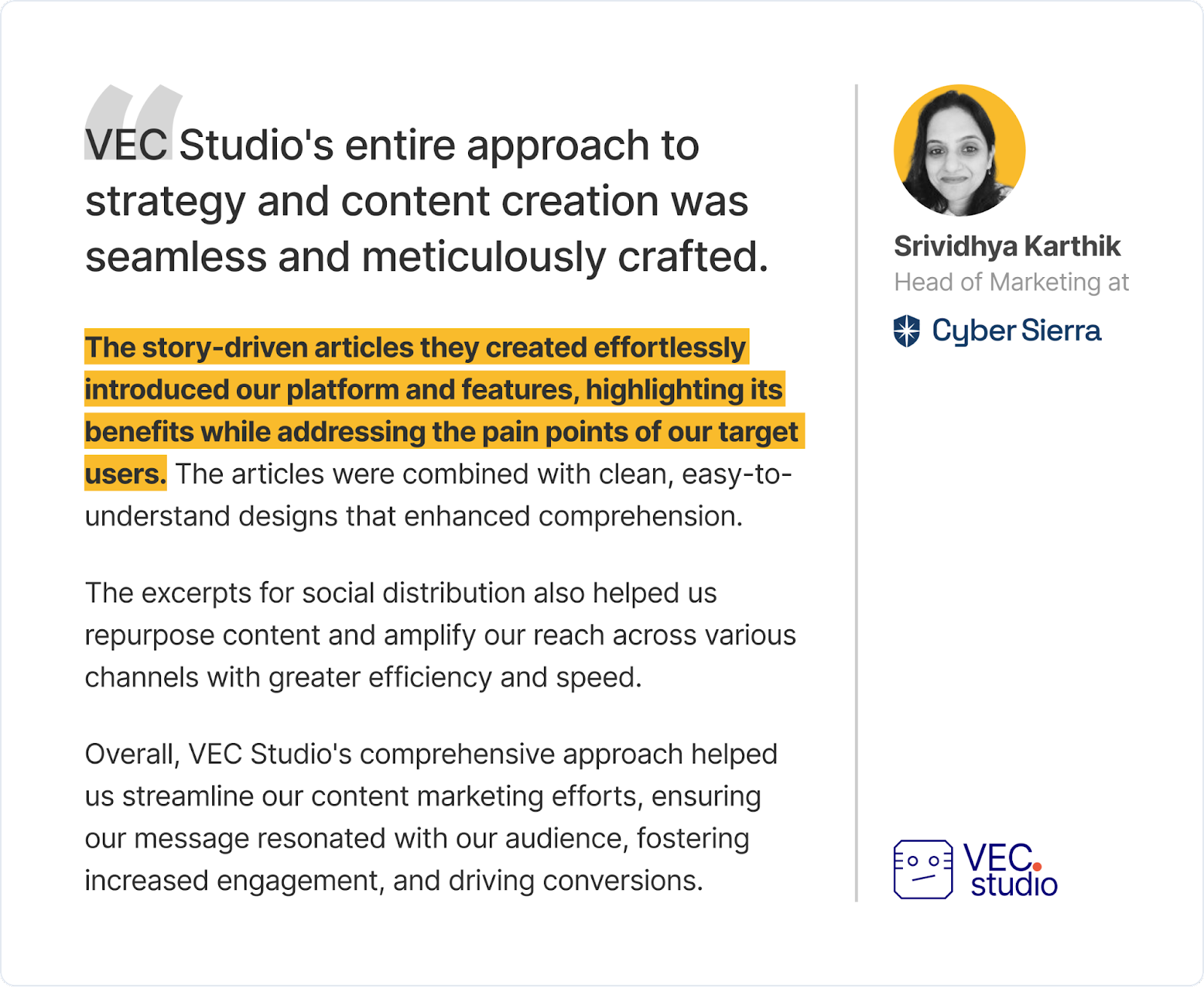
For us, it’s effectiveness way before efficiency. As such, our content strategy design and Product-Led Storytelling execution approach are all done through deep, strategic thinking. We only use AI tools where and when necessary, as outlined in the section above, to facilitate some tasks. But never to strategize and auto-generate content.
It’s probably why our work gets testimonials like this:
Prioritize Effectiveness Over Efficiency
I started this guide with a quick question.
And to conclude it, I have two quick ones:
- Will your company achieve its marketing goals by using AI to improve your efficiency of auto-generating marketing content?
- Do you agree that creating more effective content people actually want to read, and read more of, is how you can drive business outcomes?
If you answered no and yes, then consider investing the time and resources required to craft truly effective content people —your prospects and customers— actually want to read, before using AI to become efficient. Again, Jason Foster recommends this:
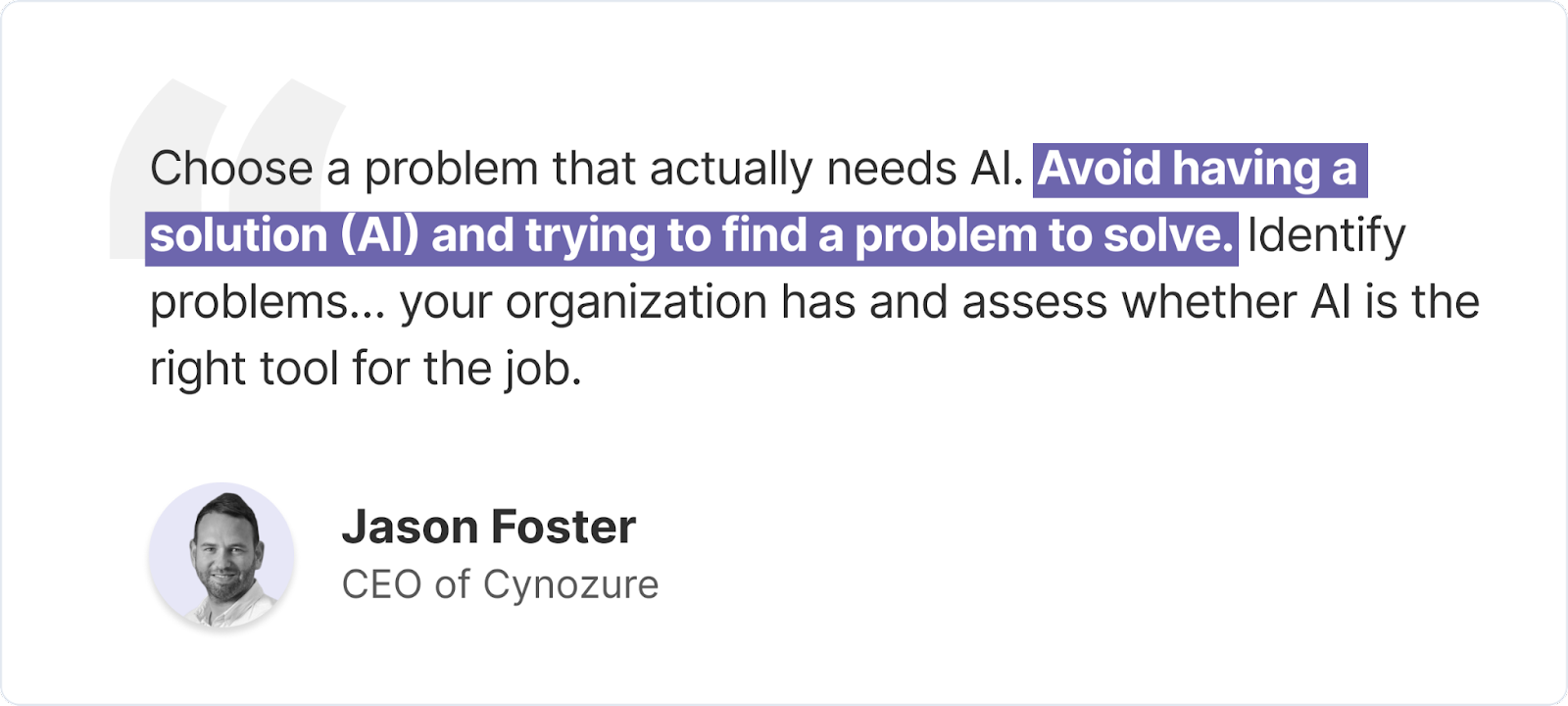
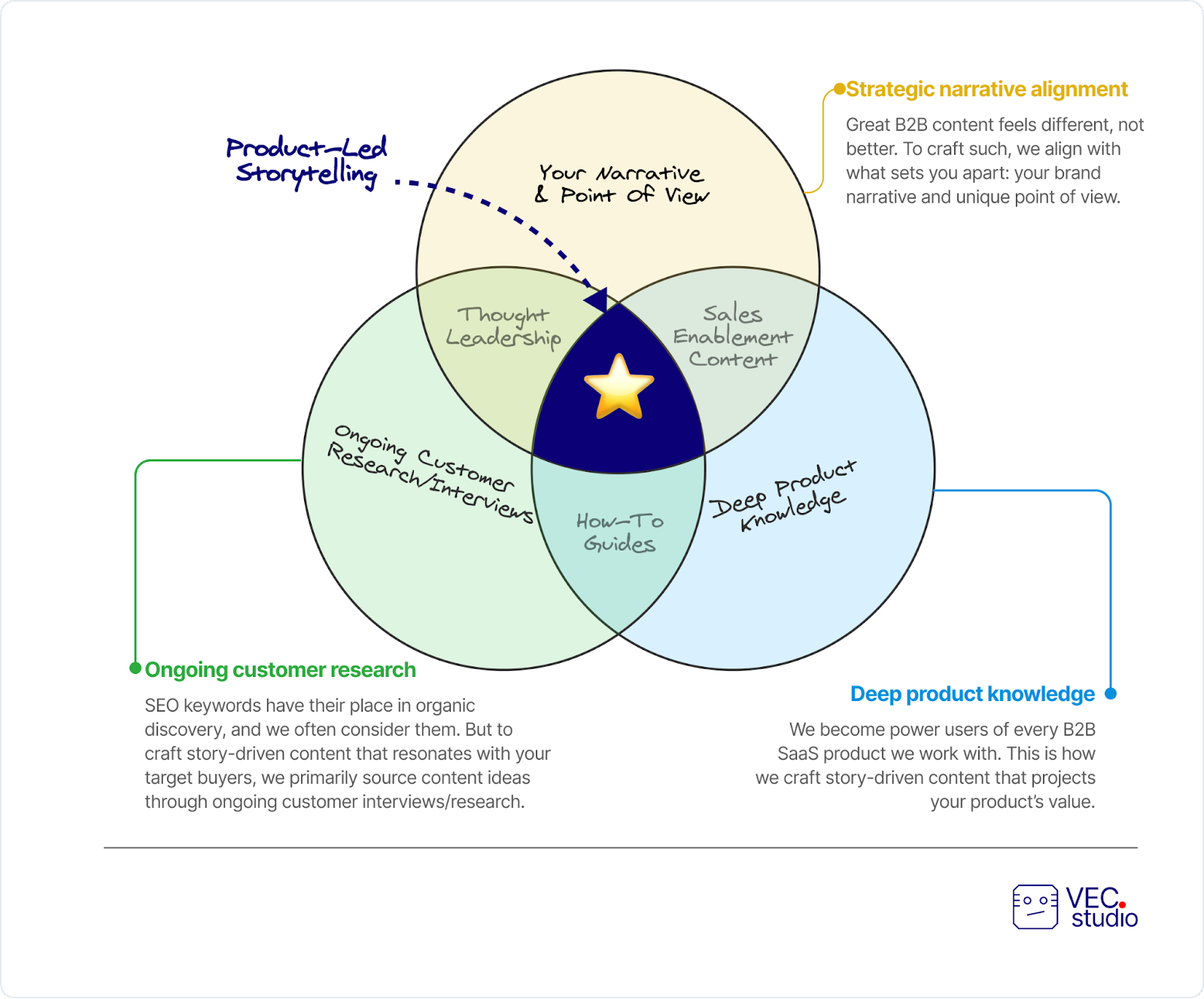
As we’ve stressed, although AI can help, solving the problem of crafting truly effective content people actually want to read doesn’t start with AI. It starts with tight strategic alignment, gathering qualitative insights through ongoing customer research and interviews, and in-depth product knowledge.
VEC Studio’s Product-Led Storytelling approach is rigorously built on these three crucial pillars before any consideration of AI:
Victor Eduoh
Lead Strategist @VEC
Founder, Lead Strategist @VEC. Thinker, reader, words-crafter, and husband to Omosede. Besides crafting product-led stories, I love scouting and grooming rare marketing talents.


Crafted with ❤️ in Port Harcourt